

A small bedroom holds a certain paradox. On the one hand, limited floor space seems like an obstacle – little room, cramped, hard to move freely. On the other, it is precisely in a small space that retro style blossoms most beautifully. A few carefully chosen pieces of furniture, warm wood, slender legs and one bold colour on the wall are enough to create an interior with soul, where the limited size is not felt at all.
The secret is that vintage-style furniture for the bedroom – especially pieces inspired by the mid-20th century – was designed with functionality and lightness in mind precisely because post-war reality demanded smart use of space. Slender legs that lift furniture off the floor, low-profile bodies, no unnecessary ornament – all this makes a retro bedroom the natural ally of a small floor plan.
Why do retro style and a small bedroom go so well together?
Mid-century modern style, the heart of the retro aesthetic, was born in an era when designers were looking for solutions for mass housing – modestly sized flats where every square metre had to work twice as hard. Hence furniture that was low, visually light, multifunctional and free of decorative superstructures that eat up space.
Compare this with a massive floor-to-ceiling fitted wardrobe or a chest of drawers with a tall, heavy body – and you will see the difference immediately. A small retro-style bedroom does not fight its floor space. It works with it.
The bed – low, stable and full of character
The bed takes up most of the floor area in a bedroom and is the first thing to determine how spacious or cramped the room feels. In retro and mid-century style, one rule applies: the lower, the better.
A low bed – with a simple upholstered frame or a wooden headboard on slender legs – visually raises the ceiling and gives a sense of space. The eye does not stop at a massive, tall headboard but wanders freely around the whole room.
The headboard should be simple and clean. Upholstered panels in naturally textured fabric – bouclé, velvet, linen – add softness and warmth without visually overwhelming the room. A wooden frame in warm oak or walnut is a classic solution that never dates as the seasons change.
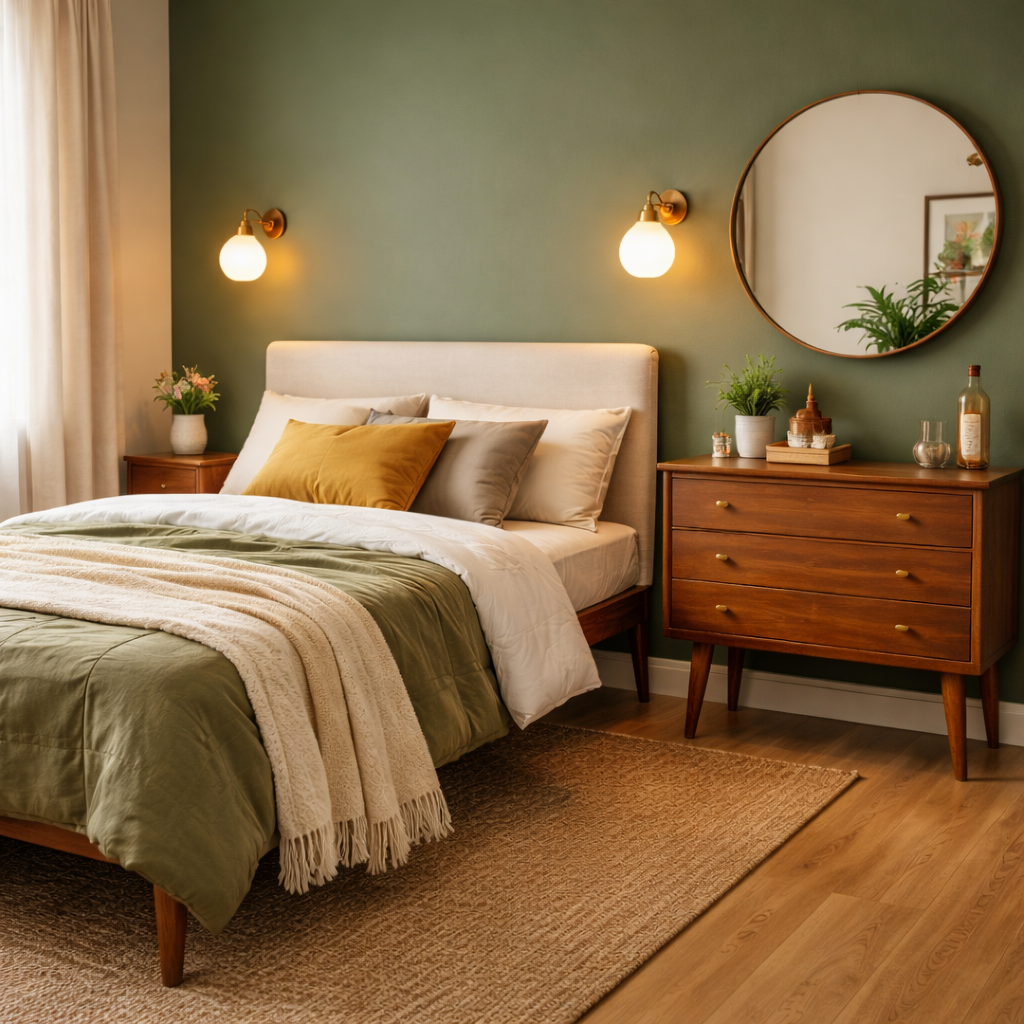
An important detail: the bed legs. In retro style, legs are slender, often slightly angled and set at the corners of the frame. The space under the bed is visible – and that is a good thing. It visually enlarges the bedroom and, practically speaking, offers room for storage underneath.
Bedside tables – less is more
In a small bedroom, bedside tables are where many people make the same mistake: they choose ones that are too big. A bulky bedside cabinet with several drawers and a wide top, placed right next to the bed, swallows up valuable space and makes the bedroom seem to shrink.
The retro aesthetic suggests a completely different approach here. A small, neat bedside table on slender legs – with one drawer, perhaps with a small shelf underneath – is all you really need. It takes up minimal space and is so visually light that the gap between it and the floor makes the bedroom feel bigger.
An alternative that is increasingly popular in small retro bedrooms is wall-mounted bedside shelves instead of freestanding tables. Fixed to the wall at the right height, with or without a small drawer, they free up the floor completely and have virtually no visual bulk.
If you do want a freestanding bedside table, look for pieces in a wood tone that matches the bed and the rest of the furniture. Consistency of material and colour is one of the most important optical tricks in a small bedroom – a uniform tone makes the room look more spacious and harmonious.
Explore our bedside tables


A chest of drawers instead of a wardrobe – a retro storage idea
In the classic retro and mid-century bedroom, a walk-in or full-height wardrobe was not the norm. Instead, the chest of drawers reigned supreme – a low, horizontal piece with several drawers that served for both storage and display. A lamp, a mirror, a few ornaments – and the chest of drawers became the centrepiece of the whole bedroom.
In a small bedroom, a chest of drawers has several serious advantages over a wardrobe. Above all, it does not reach the ceiling, so it does not feel like an obstacle or a visual barrier. It is shallower than a typical wardrobe, which can be crucial in narrow bedrooms. And – importantly for the retro aesthetic – it is a piece of furniture that simply looks good.
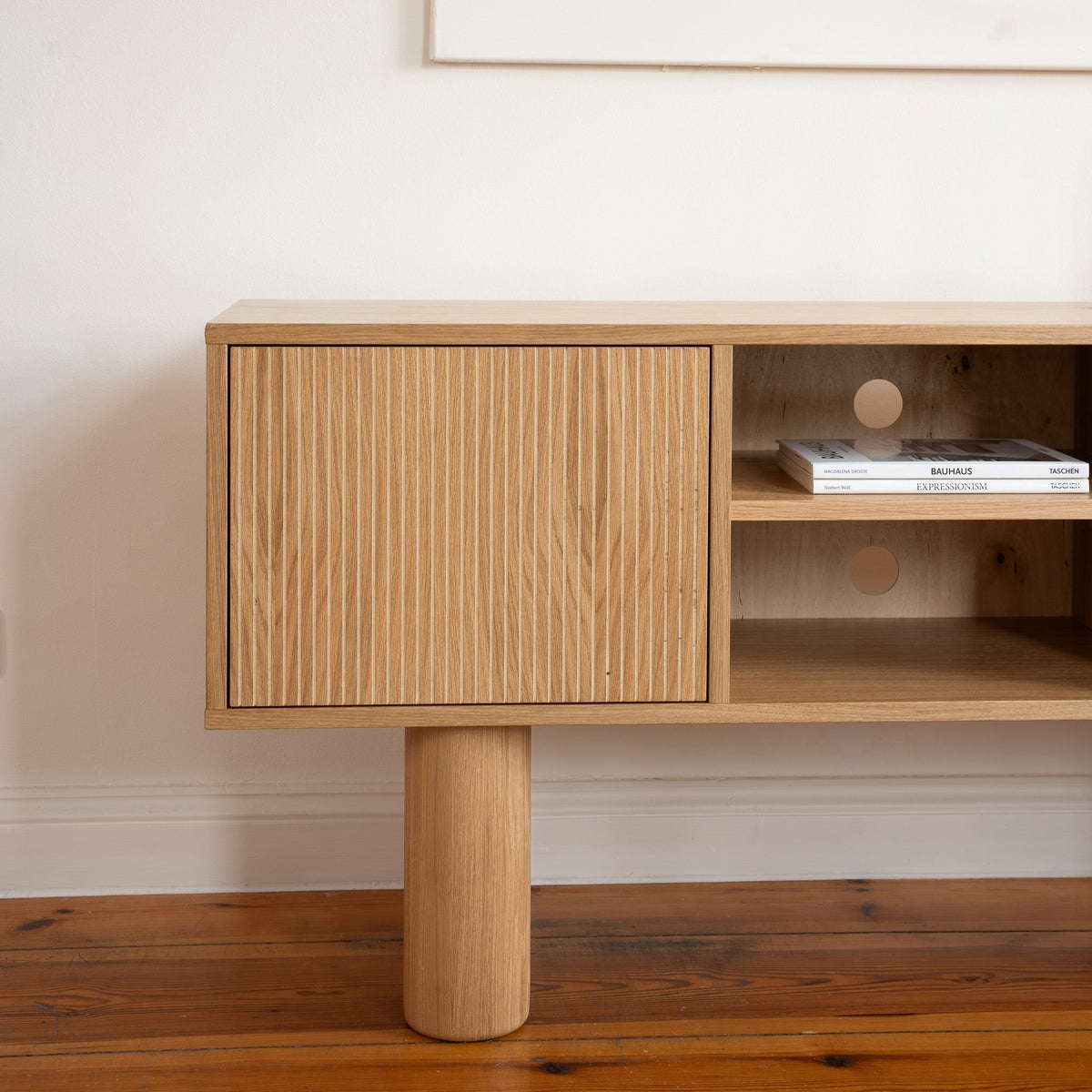
A retro-style chest of drawers has distinctive features: a low, horizontal body, angled or turned legs that lift it off the floor, drawers with brass or gold handles, and warm oak or walnut. A piece like this does more than store things – it speaks of the character of the room. If you are looking for something smaller, take a look at our small sideboards – ideal for bedrooms with limited space.
If your wardrobe needs more than a chest of drawers, consider an open clothes rail in a corner or alcove, concealed by a light natural linen curtain instead of wardrobe doors. It is a practical, inexpensive solution that is entirely in keeping with the retro aesthetic – curtains of heavy linen or cotton were a staple of 1960s bedrooms.
A desk – is there room for one in a small bedroom?
If your bedroom also serves as a small home office, choosing a retro-style desk is a matter of delicate balance. The desk must not dominate or create a work zone that visually "intrudes" on the rest area.
A retro desk for the bedroom should be neat and simple – a narrow top, slender legs, perhaps a single drawer at the side. Placed against the wall, side-on to the window, it takes up minimal space and does not disrupt the coherence of the bedroom. When the day's work is done – laptop closed, papers tidied away – the desk simply becomes another element of a matching set of wooden furniture rather than an office intrusion.
Colours and materials – how to make a small retro bedroom look bigger
In a small retro bedroom, colour should work for a sense of space, not against it. A few tried-and-tested rules:
- A light base, one bold accent. Walls in off-white, cream or soft beige create a neutral, bright backdrop that visually opens up the space. Against this backdrop, one striking colour – the wall behind the bed in deep green, navy or terracotta – adds depth and character without making the room feel smaller.
- Wood as the main material. Warm oak or walnut is a material that warms up an interior without visually crowding it. In a small bedroom, it is worth keeping the wood tone consistent across all the furniture – bed, chest of drawers, bedside tables. When the furniture forms a harmonious whole in terms of colour, the eye does not register the pieces as separate, distracting elements.
- Textiles with a light touch. A bedspread in a natural fabric – heavy cotton, bouclé, fine linen – adds cosiness without taking up space. Two, or at most three, decorative cushions are enough. Retro style is not about staging a pile of cushions but about a few carefully chosen pieces.
- Minimal lighting with maximum atmosphere. A bedside lamp with a wooden base and a fabric shade, a brass wall light by the headboard – in retro style, these kinds of lighting do a huge amount of decorative work without taking up a single centimetre of floor space.
What to avoid in a small retro bedroom
A few mistakes that are often made when decorating a small retro-style bedroom:
- Too many patterns at once. Patterned wallpaper, a patterned bedspread and a patterned rug are three elements that together create chaos – regardless of style. In a small bedroom, the rule is: one pattern at a time, everything else calm.
- Furniture too big for the space. A ceiling-height wardrobe, a tall chest of drawers, a massive headboard – each of these eats up visual space. The retro aesthetic offers an alternative: low, light, slender forms that let the space breathe.
- Too much furniture. In a small retro bedroom, fewer but well-chosen pieces work better than a full set of furniture squeezed into a small floor area. A bed, two bedside tables, a chest of drawers and perhaps a small desk – that is usually all you really need.
- Cold colours and cool materials. Retro style is about warmth – warm wood, a warm colour palette, soft fabrics. Cool grey, cold steel, sterile white – this is an aesthetic that is at odds with the spirit of the style and robs it of its most important quality: cosiness.
Summary
A small retro-style bedroom is an interior that proves floor space does not determine the beauty or character of a room. Furniture does – its form, material and proportions. A low bed on slender legs, a neat chest of drawers in warm wood, bedside tables that do not overwhelm, one bold colour on the wall and textiles in natural fabrics. That is the recipe for a bedroom you will love spending time in – no matter how many square metres it has on paper.
Start with the bed, choose a chest of drawers instead of a wardrobe, invest in slender bedside tables and one bold colour on the wall behind the headboard. The rest will fall into place.